
Pulque in Oaxaca: Discovering the Other Side of Agave
When someone arrives in Oaxaca and asks about traditional drinks, the conversation almost always turns to mezcal.
And that makes sense.
Mezcal is a magnificent expression of agave culture and a key part of Oaxaca’s identity. Yet, after so many years working with these spirits, one thing still surprises me:
many people know mezcal but have never tasted pulque.
And when they finally do try it, the reactions can vary wildly.
Some love it from the very first sip.
Others make a face that says it all.
There are those who can’t stand the aroma, and others who, after tasting it, want to know where they can find it again.
For me, that is precisely what makes pulque so interesting.
It isn’t a drink you have to understand before you try it.
First, you taste it.
Then, you discover its history.
The Other Path of the Agave
Pulque and mezcal both originate within the vast world of the agave, yet they follow very different paths.
Mezcal is produced by cooking and fermenting the agave, followed by distillation.
Pulque is a different story.
It is made from *aguamiel* (agave sap), which is then transformed through fermentation. The result is a beverage with a white appearance and a distinctive texture—slightly acidic, with a flavor profile that varies depending on the agave, the sap, and the production process.
That is why I have never felt it right to portray pulque as a sort of "lesser cousin" to mezcal.
It isn't.
It is simply another expression of the relationship Mexico has cultivated with the *maguey* plant.
And perhaps that is one of the most fascinating aspects for anyone visiting Oaxaca: discovering that the universe of agave is far greater than one had ever imagined.
A drink that begins long before the glass.
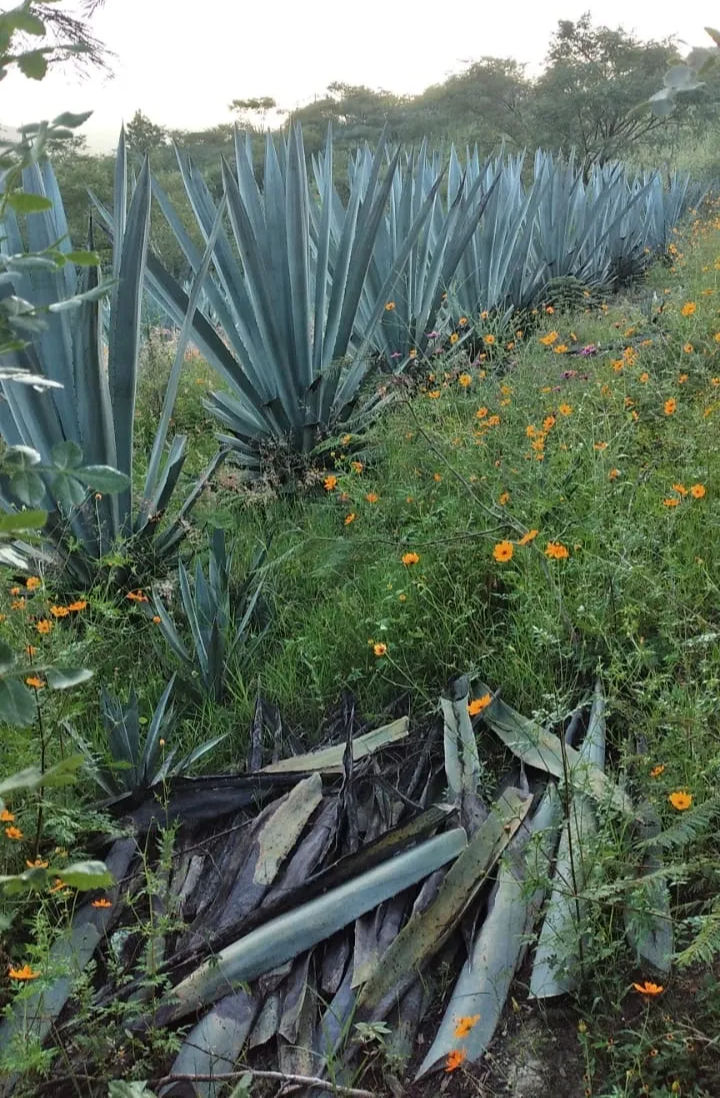
To understand pulque, you have to set aside the glass for a moment and think about the maguey.
In some of Hidalgo’s pulque-producing regions, the knowledge required to work the maguey and extract the *aguamiel* (sap) has been passed down from generation to generation. State cultural records document that producers learn techniques—such as scraping the maguey—from a young age, and that a plant can take around twelve years to reach the maturity needed to produce sap.
That changes the way you view the drink.
Because when you drink a glass of pulque, you aren't simply consuming a fermented beverage.
Behind it lies a plant that took years to reach that moment, and people who know how to work with it.
In the Llanos de Apan region—particularly in southern Hidalgo—maguey cultivation and pulque production have deep historical roots. The INAH (National Institute of Anthropology and History) documents the importance of this activity since pre-Hispanic times, as well as the immense scale pulque production later achieved on the region's *haciendas*.
Today, that history remains alive.
Not just in books.
But also in the producers who continue to work the maguey.
That’s why our pulque comes from Hidalgo.
When we decided to offer pulque in Oaxaca, we wanted to do it in a way that made sense.
Our pulque comes from Hidalgo.
The idea wasn't simply to add another drink to the menu.
We wanted to introduce our visitors to a part of Mexico they likely hadn't encountered before.
After all, someone might arrive in Oaxaca looking for mezcal and end up discovering a drink from a region with a completely different pulque tradition.
It’s an interesting connection:
Hidalgo and Oaxaca.
Two states deeply connected to the world of agave, yet with distinct histories and drinks.
The first reaction is usually the most sincere.
One of the things I love most about serving pulque is watching the reaction of someone who has never tried it before.
Sometimes, a group of foreigners hears the word "pulque" and wants to try it right away.
At other times, they buy just one glass and share it among four or five people.
Then the experiment begins.
One person takes a sip.
They smile.
Another tries it and says no.
Someone else asks:
"What is that flavor?"
And suddenly, we’re talking about fermentation, agave, Hidalgo, and Mexican history and culture.
That’s what I love about pulque.
It sparks conversation.
And we don’t need to convince anyone to like it.
In fact, I think trying to do so would be a mistake.
Pulque has a very distinct personality.
Its aroma, texture, and flavor can seem strange to someone who has never tried a fermented drink like this.
And that’s okay.
Not everyone has to fall in love with it.
The important thing is that they have the chance to discover it.
Natural and flavored pulque
That is why we offer both natural pulque and *curados*.
The natural version is the most direct way to experience the drink.
There is nothing to hide.
Its texture, acidity, aromas, and character are all right there.
*Curados*, on the other hand, offer a different point of entry.
These are preparations where pulque is combined with other ingredients to create distinct flavor profiles, and they can be more approachable for someone trying the drink for the first time.
But personally, I believe there is something important:
if you really want to get to know pulque, you have to try it natural first.
Then, you can explore the *curados*.
Pulque does not belong only to the past.
For a long time, pulque has been regarded as a drink belonging to a bygone era.
As something that was once significant but was eventually left behind.
Yet, that story is far from over.
In Hidalgo, for instance, festivals and activities centered on the maguey plant and pulque are still held today, involving producers and initiatives dedicated to keeping this tradition alive.
And there is a reason why this matters beyond mere nostalgia.
Pulque also represents a source of economic activity for the communities that produce it.
Official documents from Hidalgo acknowledge the economic importance of maguey and pulque to the region, while research into traditional cultivation methods for pulque-producing maguey highlights its potential to bolster local economies and provide various environmental services.
This suggests that taking a fresh look at pulque could be more than just a culinary trend.
It could mean restoring value to the knowledge, plants, and production methods that endure to this day.
But looking at the agave again also means being responsible.
Here is a part of the conversation that I consider especially important.
If traditional agave spirits are sparking renewed interest, we must ask ourselves what happens when that demand grows too great.
We do not want the success of a spirit to end up destroying what makes it special.
The goal should not be to plant a single variety of agave everywhere or to turn the countryside into a factory for raw materials.
The true value lies in preserving the diversity, the knowledge, and the communities that have kept these traditions alive.
Maguey can be part of agricultural systems that provide environmental and economic benefits, but that requires a knowledgeable and careful approach.
To me, that is a much more interesting way to talk about tradition.
Not as something frozen in the past.
But as something that can still have a future.
So, why try pulque in Oaxaca?
Because it’s likely something you didn’t expect to find.
You arrived looking for mezcal.
And suddenly, there in front of you is a glass of fermented agave drink from Hidalgo—with a completely different history and a flavor unlike anything you’ve likely tasted before.
You might like it.
You might not.
You might need a couple of sips to decide.
It doesn’t matter.
The important thing is to try it.
Because one of the best parts of traveling is discovering things you didn’t know you were looking for.
And for many people, pulque is exactly that:
a small doorway to another side of Mexico.
Here in Oaxaca, we’re used to associating agave with mezcal.
But agave has many stories to tell.
And pulque is one of them.
Come discover the other side of agave.


Comments